Friday, November 27, 2015


Tuesday, April 15, 2014
The long awaited Leitzinger contra "bocals" (crooks) arrive and an afternoon of London Leitzinger fun

 |
| Stephan Leitzinger at work whilst we tried contra crooks |
 |
| Alex trying Leitzinger contra crook and tuner stays rock solid! |
 |
| Me trying a beautiful new Model 1 - now the property of a young and brilliant UK player who tried it after me! |
Back in November after doing our Reed Rage set at the Big Double Reed Day on this new crook I came home and tried it no a variety of reeds and there was definitely some adjustments to be made to how I was blowing. I was so used to the infamous tenor register on the older Mollenhauer wanting to croak and go flat that I found I had acquired some interesting embouchure habits up there…it took me a while to realise that I could actually stay “open” and sing and blow as I would want to and that this register is a LOT more stable now. Sure it took some fiddling with reeds as it does when changing crooks on a bassoon, but I was impressed by the dynamic range and the ease in playing.
 |
| Too late! Alex won't let go of the contra crook. |
Leitzinger Bassoon Afternoon 31st March in London
 |
| Advice on how it all fits together |
 |
| Richard takes delivery of his new bassoon |
Thursday, December 19, 2013
Play with a Pro does it again - breathing revelations

Wednesday, May 22, 2013
My Leitzinger Bassoon Adventure
Overview:
For over a year I have been talking about getting a Leitzinger, often to the response "a what?" (and that was from bassoonist friends not string players or bus drivers). Once I had decided and ordered one the waiting began...but the great day arrived when I flew to Frankfurt to pick up my new bassoon from the workshop of Stephan Leitzinger. The days since then have been full of bassoon revelations so I thought them worth a blog post as in terms of bassoon "news" this is BIG news.

Based on my experiences over the last few years with the crooks and more recently with the bassoons I have decided that if anyone else wants to find out more then they are welcome to email me with questions. I have accumulated rather a lot of information in the last few years and want to help other UK players find out for themselves. So if you have any questions contact me by email or via the contact page on my main website and meanwhile I will try and find time to make a UK website for this information on Leitzinger bassoons.
Immediate impressions:
Fingerings (the technical bit):
After five concerts on this bassoon I am loving all sorts of unexpected things in addition to the things that I was expecting from my try outs on other Leitzinger bassoons. Top A with left hand only anyone? Adding ring finger right hand doesn't change the pitch enormously just the colour which as a left hander opens up a lot of difficult finger work to simplification! How about leaving off the endless Eb or C sharp LH little finger on all sorts of notes that I used on my old bassoon? How about top A flat simple fingering (just RH 3) being the same pitch as adding what I needed before (Bb key and RH 2 and 3) to make it sound nice? Even RH Bb and F key which is a nice slur fingering is the same pitch (and not sharp). How about forked Eb being totally fine with just a fork? Yes adding little finger LH changes the colour but it's stable without. And doesn't need RH 1 or 2 with Bb key. Top C with just LH 1 and C speaker key? No problem. Bottom F not sharp, bottom G not flat and bottom Ab not even flatter? Just blow! Bottom E D and C - not sharp. Just blow! In fact if you start doing strange embouchure changes as needed on most instruments you can make these notes flat on this bassoon - it just doesn't need that change. The list goes on. Basically my main re-learning this week has been to blow lots of lovely warm and open air down the thing and not do any strange fingerings or embouchure manipulations. This makes playing legato and playing MUSIC on it much more fun.Dynamic Range and Sound:
Then there is the pianissimo. Less air means it goes quieter. Erm obvious I know but most other bassoons I have played or tried clamp up or don't play quietly with little effort. Now when you open up and really tank it the bassoon just gets louder!
I remember seeing the Times review from Richard Morrison who had gone to see the Leipzig Gewandhaus orchestra perform Beethoven 9 in November 2011 when David Peterson (who plays a Leitzinger) was playing fag 1. The next day's review included "the principle bassoon - with a tone like a chocolate liqueur - was alone worth the price of the ticket". (Ed: found the exact clipping and quote from 7 Nov 11 and corrected this 25.5.13). And although so far I still sound like Tom playing the bassoon rather than anyone else and can't vouch for how much chocolate is coming out I can say that it is a flexible sound yet very warm. And when you blow the thing HARD it doesn't go nasty. It just gives you more sound.
The problems? Erm - keywork in a different place to my old bassoon and a fair amount of operator error. But with the provided left hand rest and right hand rest that you can move into endless different angles with an allen key I am there now and have stopped hitting the wrong keys...the last two concerts have been a joy.
The Story So Far:
- Leitzinger has been making bassoon crooks ("bocals" for those of you outside the UK) for decades. Somehow the UK didn’t hear about it but they have been big in Europe and the US for some time. They solve all sorts of tuning issues and have a flexibility and dynamic range that makes them a bit of a “once you have tried and liked you will never go back” proposition. He has also been making bassoons for some time and there are over 80 of them out there with many german players going from their favoured makers to Leitzinger. There are quite some stories on this subject!
- I met Stephan Leitzinger at 2009 IDRS in Birmingham and got my first crook from him (a silver thin walled free blowing S2V that really helped my old Mollenhauer pre war bassoon). I tried his bassoons but coming from a pre war Mollenhauer and a day of trying instruments on different stands at the show I didn’t really know which end was which by the end of the day.
- When I got my Heckel a few months later the S2V crook saved my bacon for ages as it worked on the Heckel and enabled me to make the transition from an old pre war instrument to a huge 13000 series 1980s Heckel without too much bloodshed. I then bought an MD1V for nice top notes and sharper pitch at the British Double Reed Day 2010. (the various models can be seen here - Leitzinger Crooks

Saint Saens Bassoon Sonata on Heckel 13000 series with Leitzinger crook - I carried on getting crooks from him to suit this instrument and converted quite a few other players along the way (“oh you mean the bottom doesn’t HAVE to be sharp, the tenor doesn’t HAVE to be flat and top C can actually be flat enough and not sound like a strangled ostrich” etc.etc.) My rather large collection of crooks (and my maintaining to the other members of Reed Rage that you can NEVER have too many crooks that leads to them mercilessly taking the micky out of me) is now quite impressive, though in reality I have only been using two - a lovely S2F silver for second playing and my M1F platinum described in more detail below.


- The great crook journey led me to invite Stephan Leitzinger over to the Big Double Reed Day 2011 at the Guildhall. I tried the bassoons in earnest and now appreciated that they were much easier to play quietly on as well as loud and seemed really flexible. In fact the main thing I came away with from that day was that I wanted to play MUSIC on these bassoons and not just blow scales up and down.
- After Big Double Reed Stephan emailed me to suggest I might like to get a Leitzinger bassoon. I emailed back a long hollow laugh concerning my lack of worldly riches…I am not sure how well that hollow laugh translated at the Frankfurt end of the email but the seed had been sown deep in my bassoon consciousness.
- A year passed rather quickly and I found myself at another Big Double Reed Day but with less classes of fifteen year olds playing bassoon and oboe to conduct and more time to try the bassoons. I decided after really playing a few of the bassoons on the Leitzinger stand that I was going to own a Leitzinger...only to find my fellow Reed Rager Alex Davidson had tried the demonstration model, played it to our colleagues in the hall who had gone "WOW", had fallen in love with it and announced she was buying it! That left me putting in my order knowing I would have months of waiting wondering quite how that all happened! But of course it did give me several more chances to try a Leitzinger for real and some very fruitful duet sessions with Alex where I confirmed my decision was a "sound" one.
- January 2013 came and I was given the task by an Australian player who buys reeds from me of choosing a Leitzinger from two of them that Stephan had made as she was unable to come to Europe. An ominous task (in her words “don’t screw it up”). I chose well and she has been delighted with her instrument (phew). Her email concerning her experiences made me wish I had kept the one I chose for her!
- I have been out with the Ulster Orchestra rather a lot in the past few years and got used to playing my Heckel in the Ulster Hall with its special brand of reed idiosyncrasies (read “London reeds don’t work here”…)I decided that once I had the date for picking up my bassoon that I better have the Heckel ready as a back up in case I couldn’t actually play the thing and duly left my old bassoon at my lodgings ready to revert if needed.
 |
| The Ulster Hall, Belfast |
- I flew to Frankfurt last week, (thanks to my frequent visits to the Ulster Orchestra and the air miles I have collected on BA!) and picked up the new beastie and came to Belfast for some Verdi requiem action for the end of season concerts. The expected carnage of a new instrument in the heat of the moment failed to come - it went well and I found myself much less tired in the embouchure department than usual. It has been a really pleasurable week finding out that this new machine reaches parts that other bassoons don’t reach with a flexibility that I have been searching for for a long time! My old bassoon has not been needed as a back up and I now have the interesting task of getting two bassoons back on Friday on the plane.
 |
| Two Leitzingers in conversation. |
Other Thoughts and discoveries:
 |
| My Leitzinger is darker than yours.... |
The Back Story:
This is the full story for those who have stayed with this post so far.... |
| Trondheim really is a long way north! |

The Bassoon Adventure.
The blind test:
The Trip:
Last weekend was quite a trip in bassoon terms! Arriving at Frankfurt airport having come off the early flight and been on an early flight from Belfast to London the morning before wasn't exactly my idea of a rest. And I knew I would be on the early flight back Monday morning to teach at the City of London Boys school.
 |
| Frankfurt - a modern city. |

And then as I was tired and hungry Stephan's wife Martina brought up a snack with some fantastic cheeses!

My day with Stephan Leitzinger was an exploration - could I play this new instrument or not? Reeds, some Weissenborn studies, some excerpts... all seemed to work. It also involved finding two matching crooks for the bassoon, some small adjustments to key work for my huge hands, lots of questions from me, lots of laughter and stories from both of us and Stephan back and forth from his workshop.
During the day Stephan also did some adjustments to Alex's Leitzinger that I had brought with me. I took hers with me even though this meant I would have to bring TWO Leitzingers back on the plane. And thanks to BA this was no problem.
 |
| The parking "pod" back to the car park at Terminal 5 - where I was stuck for 20 minutes - the only breakdown in technology all weekend! Still, my two friends seemed unperturbed. |
 |
| Leitzinger twins play Verdi |


I wandered off the stage and it sounded great. But then I started to walk back down the hall. It still sounded great and in fact sounded the SAME. I have done this many times as he has blown on his Fox and there is a point where most bassoons just gets a bit lost. I didn't have a chance to hear it without some violins practising and a clarinet and horn as well all twiddling through bits that we were about to play. But there it was - the bassoon sound. Not LOUD. Just lots of SOUND. Big fat German sound but not heavy. Just singing. It carried all the way to the back of the hall. Which was interesting to me as it confirmed what I had heard when comparing my bassoon to Dan's Leitzinger earlier in the year and what other players had said. In fact the feedback on these instruments from conductors and string players is what makes your bassoon ears stand up and flap in the wind!
- The Leitzinger bassoons seem quite happy on simple fingerings. In fact adding keys as I did all over the place on my old bassoon isn’t needed and interestingly doesn’t change the pitch of many of these notes - just the colour. They play well with just simple Eb, simple tenor fingerings that just work and an even scale. The hardest thing is learning to just blow and NOT compensate when years of muscle memory tries to intervene.
- They don’t seem to play sharp. I was expecting the instrument to play very sharp for UK and I still have no idea how the continental players get to 444 on a number 1 crook. With the same crook and reed my old bassoon is sharper.
- The sound character is very dark and they seem very comfortable on a reed that on other instruments would dip on E and C sharp and generally be a nightmare. In fact I went through ten reeds with my old instrument and eight of them dipped and only two were good. I then went through all ten and they ALL worked on the Leitzinger. Other players have commented on this and the fact that they can play on lighter reeds.
- The instruments seem to be quite chameleon. Alex commented that since getting her Leitzinger she has played in many different situations and found she could blend well - one with a modern Heckel, another with Puchner and another with a Moosmann as well as in her regular trio
http://www.tomhardybassoon.com/
Monday, December 17, 2012
Ole Kristian Dahl on Playwithapro.com
I loved the Sergio Azzolini ones because his passion for the music helped me love the music even more and were delivered with such conviction with a touch of Italian madness. The interview with Sergio where he describes his path to the bassoon and gives more information on Vivaldi is fantastic too.
And I was looking forward to the new bassoon videos from Ole Kristian Dahl as I had heard such good things about him as a teacher from players who had been out to Mannheim to have lessons. I have spent a few hours studying these now.
The attention to detail is astounding! These are not for the faint hearted - i.e. they are pitched at advanced students and players. He is really giving us his “hat” on how to prepare for auditions to the highest level possible. The musical ideas are great and the “bassoon fundamentals” are startling and enlightening. Here is a player who has worked and worked to hone his craft and is willing to share that journey so we can all get something out of it. It is obvious from the videos why he has become such an important teacher as well as player.
Once again the free clips on Youtube and Facebook (and the free gifts on the site) are tasters and though much more representative of the overall videos than the Azzolini clip, still leave you with questions rather than giving you all the answers. Dip in and see for yourself.
Having just finished watching the full set all in sequence and then some again with my instrument out (and of course he plays at 442 which is interesting for English players!) I can see these videos are for use again and again rather than “oh that’s nice - I wish I could do that”.
Though they can never be a total substitute for a one on one lesson you could use these to prepare and improve on endless details to work out your own plan of attack on these excerpts. And as for the bassoon basics there are some things I run into again and again with pupils, both beginner and advanced, that were described in a codified and more Scientific way than I have come across before.
Wishing you all a very Happy Christmas,
Sunday, June 10, 2012
Azzolini comes to Playwithapro.com

When Adam Simonsen (creator of www.playwithapro.com) told me that he was going to be filming Azzolini talking about Vivaldi I was more than excited. For me Sergio Azzolini’s Vivaldi recordings both on the modern bassoon and baroque bassoon have taken this music to a whole new level. It was no longer about “wow, what a lovely bassoon sound and great technique” (and there are many fine players with great recordings of Vivaldi).It became “wow this is some of the most amazingly exciting music I have heard!”. The freedom and crazy Italian expressiveness is infectious. So a chance to see him in action is something I have been waiting for since Adam told me this in 2011.
I have only spoken to a few people who have studied with Azzolini and so the chance to see him teaching for myself was a long time coming. Yesterday the masterclass went live on Play with a Pro and I didn’t drop a heart beat downloading this. I had intended to do lots of other things before the end of the day and I thought I would put the video on and make some reeds. Instead I was transfixed for over an hour and a half and didn’t move from my chair. His care, love of the music, insistence, knowledge and musicality is something I just have not seen to this degree in the world of bassoon playing that I have encoutered . As his style is so unique I was interested to see if there would be some Azzolini clones coming off the line.
The masterclass is not about this at ALL. He takes all the players in the room and works on the string parts of the concerto with them playing the bass line, viola, violin 1 and violin 2 parts before even getting to the solo part. There are musical gems in this part of the masterclass before a note of the solo part has been mentioned. And some blowing and reed advice comes up only as a consequence of the music making and not as an end in itself which is refreshing for someone like me who makes dozens of reeds for others each month and can end up fiddling and not practising or music making if I am not careful. And when one of the pupils has a reed that isn’t up to it Sergio just gives him his own reed and continues playing on the pupil’s reed (still sounding amazing!).
Some of the subjects covered are: Tempi - choosing the right one and why; length of notes, especially in basso continuo and why; when to breathe and phrasing of the music in relation to harmony and function of the notes; having a reed that will enable pianissimo attack without great effort but that has enough “wood” on the back to support the sound; tuning of notes in relation to the chord and the difference between A sharp and Bb and why; colour in sound and discussion of vibrato and rubato; fingerings for very high notes for tuning (a nice flatter top C sharp for a start!); spending the time on the music so that a performance can emerge that is truly expressive. And more!
By the end of the masterclass I was inspired to play for an hour and see if I could get anywhere the flexibility and intensity of this playing. Mmmm. Work to be done. But a real pleasure to watch! A truly generous hearted individual who cares intensely for the music and to inspire others. I am grateful to Adam Simonsen for creating such a well produced presentation and to Sergio for being a stellar individual!
Tuesday, December 20, 2011
Making bassoon reeds from tube to finished reed
I thought about making some videos of the whole process but there are already some great sites out there and some good Youtube clips. But I will share one thing right now - I changed the blade in my profiler and sharpened the one in the tipper. I had got so used to blunt blades that I hadn’t noticed how much effort and force I was using on a piece of cane and that ends up with compressed fibres and less vibration! The sharp blades are a revelation and lesson learned. I will post some pictures of the fun but meanwhile interested to hear feedback on others experiences.
Thursday, August 4, 2011
Breathing and resonance
A few months ago I found the great videos on http://www.playwithapro.com/ with Gustavo Núñez from the Concertgebouw Orchestra.
This week they have put a new video up from Berlin Phil veterans oboist Hansjörg Schellenberger and flautist Emmanuel Pahud.
The download of the first video from Schellenberger (Breathing and Blowing) is free (you have to also have the player installed from the site though you can watch a free preview). Both he and Emmanuel Pahud make some points on breathing that I have never heard before and that I found amazingly helpful. Always easier “said” rather than put into practise and done of course, but in this case it had an immediate impact on my playing.
It never ceases to amaze me how one player sounds like him or herself on whatever make of instrument they play on. In the search for an easier life we try Heckel, Fox, Moosmann, Puchner, Bell, Soulsby, Adler, Mollenhauer and so on (though I have yet to try a Leitzinger bassoon!). Also endless reed scraping and crook changing has led me to a set up that feels comfortable with a wide dynamic range. But at the end of the day I sound like Tom playing the bassoon. Even on a Chinese Lark. Which for all of us is actually a good thing as it is our individual voice.
But some of Emmanuel Pahud’s comments on resonance (especially an analogy he makes and a comment on how to open up the sinus and nose area) go a long way to explaining to me why this would be. And a practise session after watching this video was VERY fruitful (and fruity in the “resonance” department!).
So in the interest of improving sound/projection/tuning/comfort/endurance and dynamic range have a look and let me know if you agree or disagree with them and what you get out of it! I’m sure there will be as many viewpoints as there are players but either way there is something to be gained from this video.
Hats off to founder Adam Simonsen (clarinetist playing in The Royal Danish Orchestra, educated from the Juilliard School of Music, and founder of Play with a Pro) for creating this site and getting these videos done!
Friday, July 8, 2011
Guildhall School of Music and Drama bassoonists in action
A great Super Mario trio with hats and choreography on the same youtube channel too! It never ceases to amaze me how bassoonists just naturally share this zany sense of humour. On a smaller scale we have our next http://www.reedrage.co.uk/ outing on 24th July at St. Anne’s Kew in London with some great fun lined up! Maybe getting all our pupils involved for a grand finale is a good idea. So the world of bassoon ensembles is very much alive!

Tuesday, June 14, 2011
BIG Double Reed 2011
With Summer Holidays coming up it’s time to spread the news to pupils and parents to put 6th November in the diary. And there was a strong adult attendance last year too so this is for everyone!

Wednesday, May 25, 2011
Leitzinger Bassoon Crooks

I am very pleased to have found Leitzinger crooks. Stephan Leitzinger makes the most stable yet flexible bassoon “bocals” I have ever tried. These have been popular in Europe and the US and Canada for some time but few have heard of them in the UK.
Stephan makes a vast range of styles so that you can match the crook to your bassoon and reeds and performance requirements. The main feature most people notice immediately is that with the right crook the bottom is not too sharp, the tenor not too flat and the high B and C not too sharp, with the octaves more balanced and in tune on a variety of reeds. Though the first blowing of them is not always impressive in the way that an old Heckel crook can be, once in the orchestra it is the ability to creep around pianissimo and create a real fortissimo that makes these such a hit with pro players around the world.
I was pleased to see and hear Meyrick Alexander using his platinum plated MDV2 for his final concert with the Philharmonia Orchestra at the BBC Proms 2010 which sounded splendid in the Ravel Left Hand Piano concerto solo!
I currently have an S2V platinum (thin walled, great for creeping around fag2 and very responsive) an MDV1 (Ravel piano concerto, Saint Saens top E’s no problem but still lovely down the bottom so not a one trick high note crook) and the best crook I have ever tried, M1F Platinum, which seems to have been made from metal mined by dwarfs and hammered into shape with the assistance of elves and is perhaps made of “Mithril”....it is some blend of metals that Stephan Leitzinger doesn’t tell us about in detail.
More information on “Leitzinger Bocals” can be found here (as well as information on his bassoons) www.leitzinger.de/en/ins_nav_02a.html
On my Mollenhauer contra I play a very early pre war Heckel contra crook which has projection qualities I haven’t found in modern ones and have a Puchner B2 which is fabulous for sorting out the flat tenor register on these contras. I am looking forward to Stephan Leitzinger’s plans to make a contra bassoon crook coming to fruition.
Julian Partridge from the Ulster Orchestra is now also playing on a Leitzinger so we have a matched section when I play there:
“I’ve been playing Fox bassoons for over 20 years and have always used Heckel crooks with them; finding the factory Fox crooks lacking flexibility, especially for grovelling around when playing 2nd bassoon. When I was working in Hong Kong I bought a Heckel C1 which was wonderful at grovelling. But I always thought it was weak in the tenor register. Fast forward ten years and Tom showed me a Leitzinger crook, which at first I didn’t warm to, but then a few months ago he leant me an M1N and I thought “wow”. It has more resistance than my Heckel but is great in the tenor register and is supremely flexible in all registers. There are rumours of a contra crook.. can’t wait.” Julian Partridge Acting Principal Bassoon Ulster Orchestra (Now the proud owner of the M1N)
Stephan has contacted me with the idea of coming over for a small event in UK in the Autumn which would be a great chance for more of us to try these crooks.
Tuesday, May 17, 2011
New site for Musicians - play with a pro
You can see short previews on the site but I paid and watched all of the Núñez ones as I was busy making reeds and this was a change from Radio 3 and 4 (and I had enough money in my Paypal account!).
The founder is Adam Simonsen - a clarinetist playing in The Royal Danish Orchestra, and he has done a fabulous job of getting this live and working in high definition. I have been in touch with him to ask about teacher discounts and other ideas and he is very happy to receive feedback. Hats off to him for pushing the idea through from conception to a live site with all the structure in place.
The pricing is one subject that he has obviously had to think about long and hard and it isn’t cheap but seems fair.
The only Englishman on the list so far is David Campbell and Adam says this will go live in the summer. Also there is a coming soon for Sergio Azzolini which I think can’t fail to be entertaining and useful.
The production is simple but very high quality with fabulous sound so the files are huge but it all works with the software installed from the website.
http://playwithapro.com/
Tuesday, October 19, 2010
The contra bassoon vs the contraforte
I did try the contraforte at IDRS in Birmingham in 2009 and really couldn’t see how we could use it in place of the contra as it is SO very different. But from these audio clips the difference is not as huge as I thought. I would be interested to hear from contra players who have played a contra forte and especially from those who have played it in a professional orchestra and why!
http://www.guntramwolf.de/englisch/f_modern.html#kontraforte has Guntram Wolf’s information on the development and http://www.Eppelsheim.com/kontraforte.php?lang=en has sound links.
Wednesday, August 11, 2010
Helping Your Child Practise
As a parent of the budding bassoonist you play a key role in helping them make rapid progress. After all you have already found a bassoon teacher, paid for the books, the reeds, the hire or even purchase of the instrument and endured the first fantastic cow noises coming from the new addition to the family! You could of course sit back and hope that their weekly lesson of half an hour will bear fruit and transform them into the next soloist and speed their progress into the National Youth Orchestra OR you could get more involved! But how?
From my experience the pupils who get distinction in their exams and make rapid progress have a great deal of support at home. Not that you are expected to teach the bassoon - that's my job. But working with parents on ways to help their child practise constructively and regularly (without undue nagging or "pressure") and by sending recordings of lessons and "how the piece goes" by email to the parents to put on the student's ipod, I have seen a huge difference in speed of progress this year.
Most teachers keep a notebook that they send back with your child after a lesson. This lays out what they have done in the lesson, what they want the child to practise and a place for you to make notes and in some cases sign off the times that the young player has actually practised! But even in schools where this is part of the rules the practise book gets neglected. A short note from you back to the teacher in this book is a huge encouragement that we are not writing notes into a void.
The child who doesn't want to practise at all is not being discussed here - that's a different story. But the willing pupil will usually have chosen the bassoon because they have heard one being demonstrated at school by someone like me and have realised for themselves that it is a wondrous noise unlike anything else. But the sound that comes out of their bassoon (or in the case of the small ones out of their mini bassoon or tenoroon) can bear little resemblance to what they heard. And the task becomes getting enough progress FAST enough so that they can sound good and get to play in their school ensemble as that's when the real fun starts - the bassoon is really a social instrument and doesn't stand up well to years of solitary confinement.
By getting agreement on how much time they can practise (around the sports club, the swimming, the friends, the TV, and the ever increasing "homework" from school) we can then start to monitor progress. This is much more important than "time spent". Progress is what they want and we all want. If they can do this effectively in the least time and have fun whilst doing it then we are all happy. And when things are going slowly that's the time to go back and forth with notes in the book or even call to discuss. With the lazier pupils I often make this into a game of how they can practise better in less time and point out I give no rewards for time wasted blowing down the bassoon with no progress.
As a teacher I want my pupils to learn WHAT and HOW to practise so that they can see, hear and feel the progress and enjoy that progress. Some are exam driven, others reward driven and some (the ideal bassoonist) are happy to go up to their room and tinker and experiment and come back and say "I found bottom Bb!" the next week.
If you are a parent of a pupil of mine already you will know you get emails/sound files and recommendations as well as writings in the "practise book" each week. With these tools and an open dialogue back and forth the whole "learning adventure" is greatly aided.
Here's to constructive practise and happy blowing!
http://www.tomhardybassoon.com/
Thursday, July 1, 2010
The Big Double Reed Day, London 10th October 2010

It’s official - preparations for the Big Double Reed Day at the Guildhall School of Music and Drama on Sunday 10th October 2010 are not only underway, we have a WEBSITE all alive and shiny. http://www.bigdoublereed.com/
Tuesday, June 1, 2010
Crook Repairs
Sometimes a small adjustment to a crook (bocal) makes a big difference to the playing angle and playing comfort for a bassoonist and can prevent long term strain of both neck and hands. After all the bassoon doesn't naturally fit the human body by any stretch of the imagination! I have always had to do little bending of a bassoon crook for my height and playing position so that my head and hands are at a comfortable angle. I haven’t needed the full “English Bend” that some makers provide (and which Heckel used to call "berger" bend and now seem to call "flat bend") which seems to work especially well for very tall people as it drops the hands/shoulders to a comfortable height when using a seat strap, spike or dutch leg support.
If there is more than a few centimetres bending needed I have usually had a repairer do this by filling the crook with a metal that melts at boiling point (such as Field’s Metal or Woods Metal) to make sure the walls don’t split or collapse. This involves re-corking and the right materials to hand, so I have done many bends just by filling the crook with table salt to give some support internally. For a small change on a new crook this has worked. Also I have risked bending the metal with nothing inside with no bad results and indeed watched one maker bend a new crook for me in front of my eyes (though he did tell me not to watch!).
However I recently did a small bit of bending on a crook which resulted in not only a split but a split right across and I suddenly found myself with two bits. Aaargh. My "crook bending without a safety belt on" days are over.
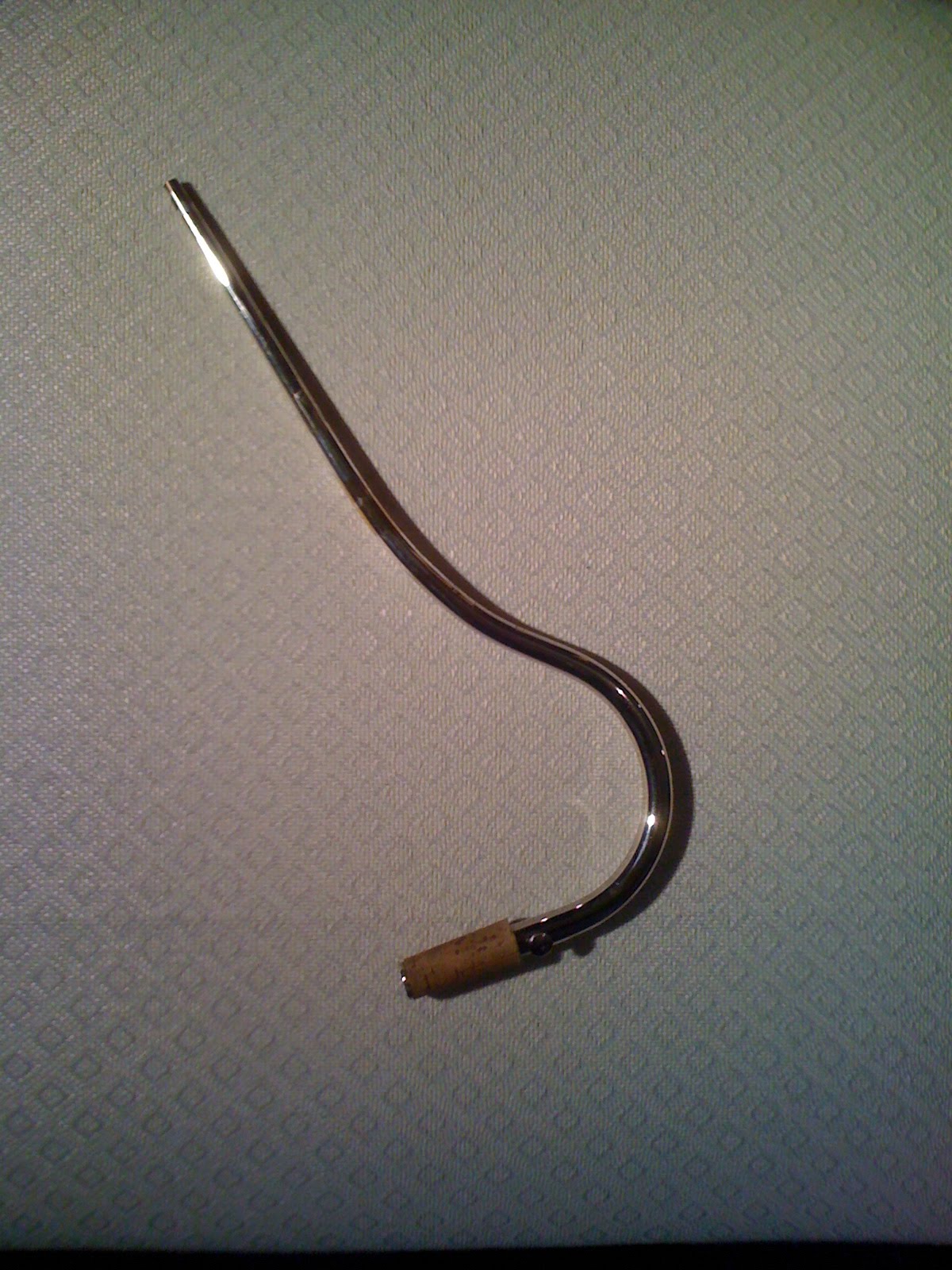

David Lock is a name known to most UK bassoonists. He has not only produced endless supplies of reeds and contra bassoon reeds for decades, he has also saved the day on repairs for many years. Although he is reluctant to take on metal work these days he has a very talented son Steve who lives a few minutes away from him (in deepest Suffolk) and repairs oboes, clarinets and of course bassoons! This week Steve saved the day by repairing the mess I had made below. Not only repaired, but actually works better than before! (Though I wouldn’t recommend it as a regular method of softening up a crook). Steve tells me he is totally happy to take on more bassoon repairs and I would highly recommend him: steve@utopians.co.uk
Though of course I am hoping not to repeat my mistake on unsupported crook bending again!
Thursday, March 25, 2010
Bassoon Reed Reamers

Having bought and cursed a variety of reamers over the years from cheap to very expensive I have recently found one that ticks ALL the right boxes and is really the Rolls Royce of reamers!
It reams out the back of a reed a) rapidly b) without blisters on my left index finger (I’m left handed) c) wet or dry d) right into throat - so throat is left a uniform size and remedied if I have made the throat a bit too small e) with a ring round the top of the reamer to set the depth I want it to go onto the bassoon crook. Oh and f) it's SHARP. Very sharp!
I usually make reeds in batches of ten and used to dread the reaming bit as ten in a row was cramp and blister inducing! This is now more like pealing some potatoes but more fun.
I have tried Pisoni, Rigotti, Reiger (and still use the diamond finishing reamer when out and about to keep in my bassoon case) and some lesser known and often ended up using a combination of them in the finishing process. All a bit painful really (literally!)
The supplier of the magic reamer?
Barrick Stees - Assistant Principal Bassoonist of the Cleveland Orchestra. He teaches at the Cleveland Institute of Music and the University of Akron. The reamer was designed by Ken Potsic
http://steesbassoon.com/
Look under "products"
In fact the whole site is something I have referred to again and again over the last two years as I have found his reed making advice very very sound and helpful.
Monday, March 8, 2010
Monday, February 22, 2010
The aches and pains of bassooning
After the initial frustration of wanting instant results and Fiona pointing out that years of habit are not undone in five minutes I settled down into a routine of using AT to make changes. I found that keeping regular lessons and sessions made a huge difference as big gaps in between just led to old habits slipping in. However, a year down the line I can see a big difference in my general posture and more importantly I don't HURT all the time! If my back or muscles become painful I know I can control this and take the time to use the techniques to get me back on track. I had wanted something where I could do all the work and not go to someone to "treat" or "adjust me" and most of the work in Alexander Technique is indeed on your own. However, my concept of being able to do it all myself was only partially correct as the hands on work from someone trained is essential and makes all the difference between success or failure and has yielded much faster results.
As there are immediate benefits and long term improvements to be had I continue to work on using more and more of what I have been learning. And this of course is starting to pay dividends with my breathing and posture when playing. And nobody seems to mind me lying on the floor with a book under my head before a gig as long as I don't clutter up the corridor too much...
I can't stress enough just how vital learning this technique is for any performer as we all put our bodies through twists and contortions to play/sing/dance or whatever. But of course it applies just as much for anyone in any walk of life as good posture and freedom from back pain makes life a lot more fun!
For those in London Fiona Bryan teaches from home and can be found at
http://www.dulwichtherapyrooms.co.uk/#/alexander-technique/4536349747
There is also a great book that covers the basics well called Body Breath and Being by Carolyn Nicholls.

Wednesday, October 14, 2009

