Thursday, July 1, 2010

The Big Double Reed Day, London 10th October 2010


It’s official - preparations for the Big Double Reed Day at the Guildhall School of Music and Drama on Sunday 10th October 2010 are not only underway, we have a WEBSITE all alive and shiny. http://www.bigdoublereed.com/

Tuesday, June 1, 2010

Crook Repairs

Sometimes a small adjustment to a crook (bocal) makes a big difference to the playing angle and playing comfort for a bassoonist and can prevent long term strain of both neck and hands. After all the bassoon doesn't naturally fit the human body by any stretch of the imagination! I have always had to do little bending of a bassoon crook for my height and playing position so that my head and hands are at a comfortable angle. I haven’t needed the full “English Bend” that some makers provide (and which Heckel used to call "berger" bend and now seem to call "flat bend") which seems to work especially well for very tall people as it drops the hands/shoulders to a comfortable height when using a seat strap, spike or dutch leg support.

If there is more than a few centimetres bending needed I have usually had a repairer do this by filling the crook with a metal that melts at boiling point (such as Field’s Metal or Woods Metal) to make sure the walls don’t split or collapse. This involves re-corking and the right materials to hand, so I have done many bends just by filling the crook with table salt to give some support internally. For a small change on a new crook this has worked. Also I have risked bending the metal with nothing inside with no bad results and indeed watched one maker bend a new crook for me in front of my eyes (though he did tell me not to watch!).


However I recently did a small bit of bending on a crook which resulted in not only a split but a split right across and I suddenly found myself with two bits. Aaargh. My "crook bending without a safety belt on" days are over.
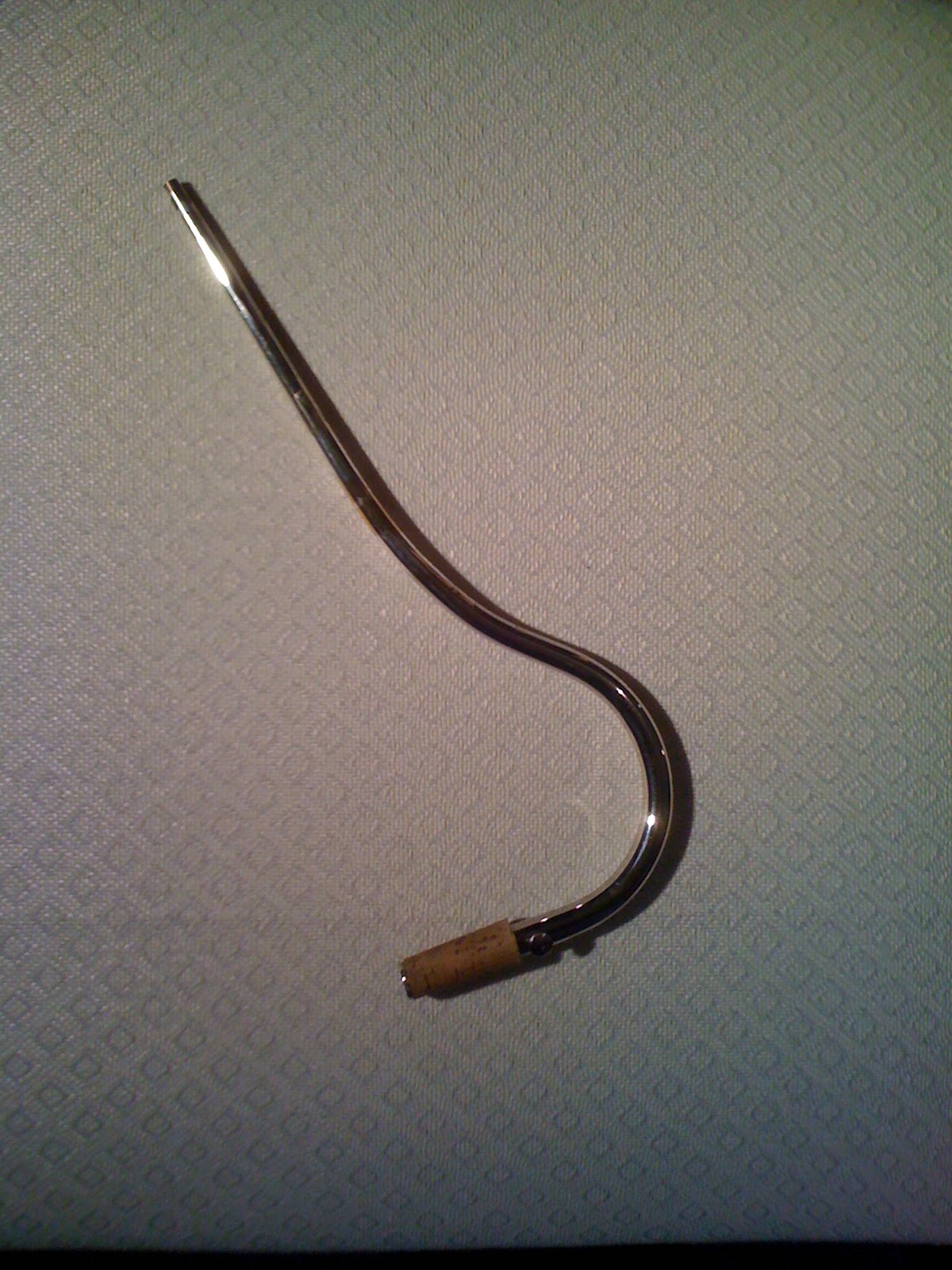


David Lock is a name known to most UK bassoonists. He has not only produced endless supplies of reeds and contra bassoon reeds for decades, he has also saved the day on repairs for many years. Although he is reluctant to take on metal work these days he has a very talented son Steve who lives a few minutes away from him (in deepest Suffolk) and repairs oboes, clarinets and of course bassoons! This week Steve saved the day by repairing the mess I had made below. Not only repaired, but actually works better than before! (Though I wouldn’t recommend it as a regular method of softening up a crook). Steve tells me he is totally happy to take on more bassoon repairs and I would highly recommend him: steve@utopians.co.uk

Though of course I am hoping not to repeat my mistake on unsupported crook bending again!

Thursday, March 25, 2010

Bassoon Reed Reamers


Having bought and cursed a variety of reamers over the years from cheap to very expensive I have recently found one that ticks ALL the right boxes and is really the Rolls Royce of reamers!

It reams out the back of a reed a) rapidly b) without blisters on my left index finger (I’m left handed) c) wet or dry d) right into throat - so throat is left a uniform size and remedied if I have made the throat a bit too small e) with a ring round the top of the reamer to set the depth I want it to go onto the bassoon crook. Oh and f) it's SHARP. Very sharp!

I usually make reeds in batches of ten and used to dread the reaming bit as ten in a row was cramp and blister inducing! This is now more like pealing some potatoes but more fun.

I have tried Pisoni, Rigotti, Reiger (and still use the diamond finishing reamer when out and about to keep in my bassoon case) and some lesser known and often ended up using a combination of them in the finishing process. All a bit painful really (literally!)

The supplier of the magic reamer?

Barrick Stees - Assistant Principal Bassoonist of the Cleveland Orchestra. He teaches at the Cleveland Institute of Music and the University of Akron. The reamer was designed by Ken Potsic

http://steesbassoon.com/

Look under "products"

In fact the whole site is something I have referred to again and again over the last two years as I have found his reed making advice very very sound and helpful.

Monday, February 22, 2010

The aches and pains of bassooning

Last year I was experiencing a great deal of discomfort playing the bassoon and contra bassoon. I ended up going for some physio to help correct this but it only made matters worse. I met another bassoonist, Fiona Bryan, on a gig and commented on her great posture and said "ah Alexander Technique". When she told me she taught it I immediately asked for a lesson. Somewhere in the back of my mind I knew I should return to Alexander Technique as I had seen it work on others and had a brief attempt to get lessons whilst I was studying at the Guildhall! (In those days it was only the string players who got this as part of their course.. times have changed).

After the initial frustration of wanting instant results and Fiona pointing out that years of habit are not undone in five minutes I settled down into a routine of using AT to make changes. I found that keeping regular lessons and sessions made a huge difference as big gaps in between just led to old habits slipping in. However, a year down the line I can see a big difference in my general posture and more importantly I don't HURT all the time! If my back or muscles become painful I know I can control this and take the time to use the techniques to get me back on track. I had wanted something where I could do all the work and not go to someone to "treat" or "adjust me" and most of the work in Alexander Technique is indeed on your own. However, my concept of being able to do it all myself was only partially correct as the hands on work from someone trained is essential and makes all the difference between success or failure and has yielded much faster results.

As there are immediate benefits and long term improvements to be had I continue to work on using more and more of what I have been learning. And this of course is starting to pay dividends with my breathing and posture when playing. And nobody seems to mind me lying on the floor with a book under my head before a gig as long as I don't clutter up the corridor too much...

I can't stress enough just how vital learning this technique is for any performer as we all put our bodies through twists and contortions to play/sing/dance or whatever. But of course it applies just as much for anyone in any walk of life as good posture and freedom from back pain makes life a lot more fun!


For those in London Fiona Bryan teaches from home and can be found at
http://www.dulwichtherapyrooms.co.uk/#/alexander-technique/4536349747


There is also a great book that covers the basics well called Body Breath and Being by Carolyn Nicholls.

Wednesday, October 14, 2009


"Reed Rage" filled Burgh House in Hampstead on 12th October with an enthusiastic and attentive audience for a programme of Bassoon Quartets, including the European Premiere of "Dance of the Polar Bears" by Gernot Wolfgang as well as many delightful ditties. Although the room did seem to contain a fair smattering of bassoonists in the audience, there were a couple of dozen people who had probably never even blown a bassoon or made a reed. No doubt they were closely related in other ways to the bassoonists in the room and had been dragged along. The feedback was most positive and confirmed that this is indeed a superior genre and may well replace the string quartet in the 23rd century.
The whole event was highly entertaining and coincidentally was finished in Ye Olde White Bear public house though no live Polar Bears were seen. More pictures can be seen on Picasa

Posted by Picasa

Friday, July 24, 2009

Basssoon Teaching and Reed Making with Adult pupils

I have really enjoyed the coaching I have done with adults in the last few months - both sectional rehearsals for orchestras and one on one teaching. It's a very different experience to taking rehearsals with fourteen year olds! Both are fun, but the adult amateur world gathers together some very bright people who really want to make the best music they can.

On the subject of teaching bassoon players and teaching reed making one on one I asked one recent pupil - a very advanced amateur who has an encyclopaedic knowledge of chamber music repertoire - to write a few words on how he got on:

"In a matter of minutes Tom Hardy had singled out the right crook for my setup from among many. He then specified the right scrape for this crook and this reed, and proved it with a few deft scrapes to my number two reed, which then instantly became my number one reed! Invaluable session!"

He also said:

"I had reached a very low limit of staccatto speed. Tom Hardy took one look at what I was doing and not only showed me what was slowing it down, but followed that up with a written set of exercises for me in particular to keep me from falling back into bad habits. Extremely useful. I will go back regularly from now on." Hugh Rosenbaum.

Couldn't have put it better myself, so I won't! Thanks Hugh!